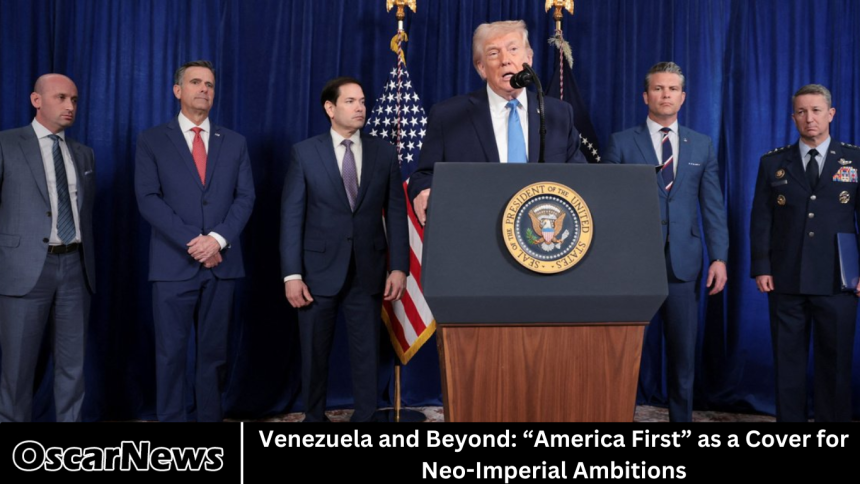
When Donald Trump talks about “America First,” he frames it as a simple promise: protect jobs, secure borders, defend national interests. That slogan sounds familiar, even harmless. But behind the slogan lies a much older political logic: using patriotic language to justify foreign domination.
Nowhere is this clearer than in the case of Venezuela, a nation that has endured years of U.S. pressure, sanctions, political interference, and covert support for regime change. When Washington claims to support “democracy” and “human rights,” critics argue the real goal is control over oil, strategic influence, and regional power.
The question isn’t just about Venezuela. It’s about a pattern: “America First” language masking neo-imperial ambitions across Latin America and beyond.
Why Venezuela Matters
Venezuela sits on the world’s largest proven oil reserves. It’s a nation with immense natural wealth and a history of resisting foreign dominance. That resistance has made Venezuela a target.
Under Trump, the U.S. increased sanctions on Venezuela’s government, targeting key industries, financial systems, and even humanitarian supplies. The stated goal: pressure the government into political change. The result: deepening economic collapse, worsening poverty, and increased suffering for ordinary Venezuelans.
Even when the U.S. claims its policy is about “freedom,” the real impact is economic strangulation.
This is where the rhetoric becomes crucial. “America First” sounds like defense, but the tactics look like punishment. The slogan becomes a tool for foreign coercion, not national protection.
More Read: 2026 Opens with a More Autocratic U.S. Rising on the World Stage
The Neo-Imperial Playbook
Neo-imperialism doesn’t look like colonial flags and marching soldiers. It looks like:
-
Sanctions
-
Covert support for opposition groups
-
Media manipulation
-
Economic pressure
-
Strategic alliances
-
Military threats
-
Political destabilization
This is modern imperialism: control without occupation.
In Venezuela, the U.S. has used economic sanctions to weaken the state, while supporting opposition leaders and creating narratives that portray the government as illegitimate. The result: a divided nation, suffering civilians, and international chaos.
This isn’t “America First.” It’s America’s dominance first.
“America First” vs. Actual American Interests
Proponents argue that Trump’s approach protects U.S. interests. But critics ask:
Whose interests?
Sanctions often hurt ordinary people more than leaders. Venezuelan citizens face shortages of medicine, food, and basic services. Meanwhile, U.S. corporations and allies benefit from destabilization.
The irony is clear: “America First” becomes “American Corporations First.”
A true “America First” policy would:
-
Reduce military interventions
-
Promote diplomatic solutions
-
Support humanitarian aid
-
Protect civilian lives
-
Respect national sovereignty
Instead, the policy follows a familiar pattern: use nationalistic language to justify foreign intervention.
The Global Pattern
Venezuela is not an isolated case. Similar patterns appear in:
1. Iraq
The “weapons of mass destruction” narrative used patriotic language to justify invasion. The result was chaos, destabilization, and regional power shifts.
2. Libya
“Humanitarian intervention” turned into regime collapse and long-term chaos. Today, Libya remains fractured.
3. Syria
U.S. involvement has shifted based on strategic interests, often at the cost of civilian safety and stability.
4. Iran
Sanctions have created economic devastation, while political rhetoric frames it as national security.
Across regions, the same pattern repeats: “national security” language covers strategic control.
How “America First” Enables Neo-Imperialism
The genius of the slogan is that it sounds protective, not aggressive.
“America First” can justify:
-
Economic pressure
-
Military threats
-
Political manipulation
-
Regime change
-
Resource control
The slogan becomes a moral shield. It prevents public scrutiny because it sounds like patriotism.
But patriotism does not justify coercion.
A nation that truly values freedom must respect the sovereignty of other nations. A strong country doesn’t need to dominate weaker ones. A strong country respects diplomacy, not threats.
Why This Matters for U.S. Politics
The rise of nationalist rhetoric has become central to modern American politics. But nationalism can easily become a mask for power grabs.
Trump’s “America First” isn’t just a slogan. It’s a strategy:
-
Build public support through patriotism
-
Use economic pressure to enforce compliance
-
Support opposition forces to weaken governments
-
Use military threats to intimidate
-
Claim moral superiority to justify intervention
This strategy benefits elites and corporations who gain access to resources and markets.
Meanwhile, ordinary citizens in targeted countries pay the cost.
The Human Cost of Neo-Imperialism
Venezuela’s crisis is not just political. It’s human.
Families flee. Hospitals lack medicine. Children face malnutrition. Basic infrastructure collapses. The nation loses its stability, culture, and future.
When sanctions increase, people suffer. When political interference increases, conflict grows. When military threats rise, fear rises.
This is the real impact of “America First” policies disguised as moral action.
The Alternative: Real American Leadership
Real leadership would mean:
-
Diplomacy instead of sanctions
-
Humanitarian aid instead of economic warfare
-
Respect for sovereignty
-
Multilateral solutions
-
Support for democratic institutions
-
Focus on stability and peace
America can lead without dominating.
A powerful nation can support global stability without forcing other nations into submission.
What Should People Do?
Awareness matters.
Citizens must question slogans. They must examine policies. They must understand that nationalist language can mask foreign domination.
If “America First” becomes a shield for neo-imperial ambitions, the world becomes less safe, less stable, and more divided.
To stop this, people must:
-
Demand transparency
-
Support diplomacy
-
Oppose sanctions that harm civilians
-
Resist political manipulation
-
Promote global cooperation
Frequently Asked Question
What does “America First” mean in this context?
It’s a political slogan that frames U.S. foreign actions as protecting national interests, but critics argue it often hides strategic control and dominance over other nations.
How does Venezuela fit into this argument?
Venezuela has been targeted by U.S. sanctions and political pressure, which many see as a way to influence its government and access resources, especially oil.
What is neo-imperialism?
Neo-imperialism refers to modern forms of domination where powerful countries control weaker nations through economic pressure, political interference, and military threats instead of direct colonization.
Are sanctions considered a form of neo-imperialism?
Yes, many critics argue sanctions are used to weaken governments and force compliance, causing severe harm to civilians while advancing geopolitical goals.
What is the main criticism of Trump’s foreign policy?
The main criticism is that “America First” is used to justify aggressive tactics abroad while prioritizing U.S. influence and corporate interests over human rights and sovereignty.
How does this pattern affect other countries?
Similar tactics have been used in places like Iraq, Libya, Syria, and Iran, where interventions were justified with patriotic or humanitarian rhetoric but led to instability and conflict.
What is the alternative to neo-imperial foreign policy?
True leadership would focus on diplomacy, multilateral cooperation, humanitarian aid, and respecting sovereignty rather than using force, sanctions, or coercion.
Conclusion
“America First” sounds like a simple promise. But in practice, it has become a cover for a deeper strategy: neo-imperial ambition. Venezuela shows how economic pressure, political interference, and military threats can destabilize a nation. It shows how powerful countries can use patriotic language to justify domination.
The future of global politics depends on whether nations choose cooperation or coercion. If America wants true leadership, it must stop using slogans to justify control. It must stop treating other nations as resources. It must choose diplomacy, respect, and peace. Only then will “America First” truly mean what it claims.