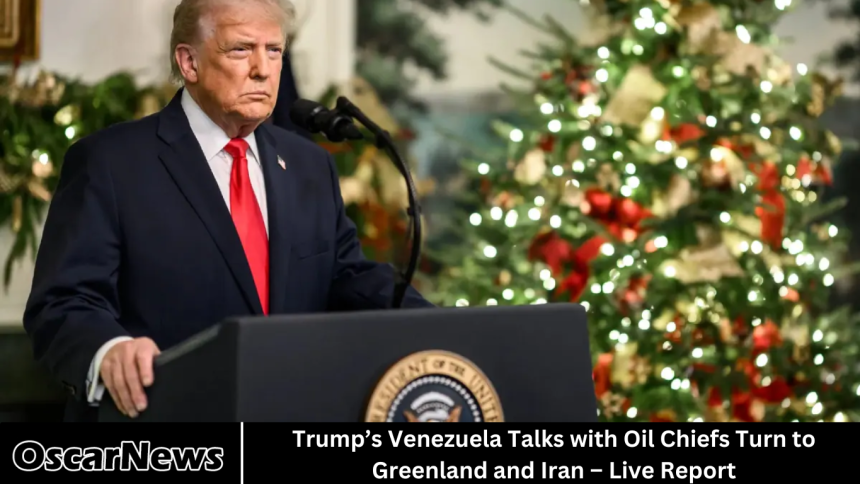
In a meeting that drew international attention, former President Donald Trump engaged top oil executives in discussions centered on Venezuela, while unexpectedly expanding the conversation to include Greenland and Iran. The high-stakes gathering, which was intended to address energy policies, sanctions, and U.S. influence in South.
America quickly evolved into a broader geopolitical dialogue, highlighting Trump’s distinctive approach to global energy and foreign relations. This live report explores the developments, implications, and reactions surrounding the meeting, examining how Venezuela’s ongoing crisis intersects with U.S. strategic interests in other regions.
Venezuela at the Center of the Discussion
Venezuela, with its vast oil reserves, has long been a focal point of U.S. foreign policy. During the meeting, Trump emphasized the strategic importance of Venezuelan oil and criticized the current administration’s handling of sanctions and energy diplomacy. He argued that stronger engagement with oil companies could help counter the influence of regimes perceived as hostile to U.S. interests.
The discussion touched on potential partnerships, supply chain adjustments, and market interventions, with Trump advocating for policies aimed at maximizing energy leverage while minimizing economic risks to American consumers. Oil executives at the meeting appeared attentive to Trump’s framing of the Venezuelan situation.
Several participants highlighted concerns about market stability, production challenges, and the legal complexities of investing in a country under international sanctions. Trump responded by suggesting that regulatory reforms and targeted incentives could encourage investment and increase U.S. influence in the region.
Analysts noted that his approach combined elements of assertive diplomacy with economic pragmatism, reflecting his longstanding focus on energy as a tool of both domestic policy and international strategy.
More Read: 6 GHz Spectrum to Be Shared by Mobile and Wi-Fi Services
Greenland Enters the Conversation
Unexpectedly, Trump shifted the discussion to Greenland, a territory with significant mineral resources and a growing strategic profile in the Arctic. He raised the possibility of expanding U.S. involvement in Greenland’s energy and mining sectors, framing the territory as a critical point for long-term energy security.
While Greenland is not a major oil producer compared to Venezuela, its rare earth elements and potential fossil fuel reserves have attracted international attention. Trump’s comments suggested an interest in establishing a stronger American presence to counter the influence of other global powers, particularly China and Russia, in the Arctic region.
Experts observing the meeting interpreted this pivot as an example of Trump’s tendency to connect seemingly unrelated topics under a broader geopolitical lens. By linking Venezuela, Greenland, and Iran, he framed energy policy as inseparable from global strategic positioning.
This approach resonated with some industry executives, who viewed U.S. expansion into emerging energy markets as an opportunity for growth and security, while others expressed caution about overextension and political backlash.
Iran and Energy Geopolitics
The conversation also turned to Iran, another country with vast oil reserves and a contentious relationship with the United States. Trump criticized existing policies, arguing that current sanctions and diplomatic efforts were insufficient to secure U.S. interests in the Middle East. He suggested that increased coordination with private energy companies could provide leverage, allowing the U.S. to influence global oil markets and counter adversarial activities.
While specific policy proposals were not disclosed, the discussion implied a willingness to explore unconventional strategies for asserting American influence over energy production and distribution in the region. Iran’s inclusion in the meeting underscored Trump’s focus on the global interconnectedness of energy and security. By linking Iran with Venezuela and Greenland, he framed energy policy as a multi-continent strategy.
Analysts noted that such a perspective highlights potential tensions between short-term market interventions and long-term geopolitical considerations, as the U.S. navigates relationships with multiple countries simultaneously. The discussion also raised questions about the feasibility of private-public collaboration in foreign policy, a recurring theme in Trump’s approach to leadership.
Reactions from Industry Leaders
Reactions from the attending oil executives were mixed. Some welcomed Trump’s assertive stance, seeing it as an opportunity to expand operations and influence policy. Others expressed caution, noting the political and regulatory risks associated with investing in regions under sanctions or with complex international relations.
Several executives emphasized the importance of stable markets and consistent policy guidance, suggesting that rapid shifts or public threats could create uncertainty that hampers business planning. The meeting also provided insight into the evolving priorities of the energy sector.
Executives increasingly consider geopolitical factors alongside traditional business concerns, recognizing that energy markets are influenced by international tensions, regulatory frameworks, and emerging technologies. Trump’s discussion of Greenland, for example, highlighted the growing interest in rare earth elements and Arctic energy resources, areas that have traditionally been peripheral but are now central to strategic planning.
Implications for U.S. Foreign Policy
The meeting’s broader implications extend beyond immediate energy concerns. By linking Venezuela, Greenland, and Iran, Trump signaled a willingness to consider a comprehensive, globally integrated approach to U.S. foreign policy. This strategy prioritizes energy as both an economic tool and a geopolitical lever, reflecting his long-standing emphasis on resource-based influence.
Observers suggest that such an approach could reshape U.S. engagement with both allies and adversaries, particularly in regions where energy resources intersect with strategic interests. Some analysts argue that this model of policy, blending private sector engagement with state-level diplomacy, presents both opportunities and risks.
On one hand, collaboration with industry can enhance leverage and create innovative solutions for resource management. On the other, it may blur the lines between public responsibilities and corporate interests, raising ethical and strategic questions about accountability, transparency, and long-term sustainability.
Venezuela’s Complex Energy Landscape
Understanding Venezuela’s role in the meeting requires a closer look at the country’s energy landscape. Venezuela possesses some of the world’s largest proven oil reserves, yet decades of mismanagement, political turmoil, and sanctions have limited production and investment.
The U.S. has historically leveraged its influence to encourage regime change, promote market stability, and secure access to Venezuelan oil, often through diplomatic and economic pressure. Trump’s discussion with oil executives reflects a continuation of this strategic interest, emphasizing potential solutions through private sector engagement and international coordination.
Oil industry insiders note that Venezuela’s recovery depends on multiple factors, including political stability, infrastructure investment, and compliance with international regulations. While the U.S. plays a significant role in shaping these outcomes, private companies must navigate complex legal frameworks, operational risks, and fluctuating market conditions.
Trump’s proposals, though largely conceptual during the meeting, aimed to bridge these challenges by aligning corporate interests with strategic policy objectives.
Greenland and Arctic Energy Potential
Greenland’s appearance in the conversation highlights emerging energy and resource opportunities in the Arctic. Melting ice caps have revealed access to previously untapped reserves, while strategic location makes Greenland significant for shipping, military, and resource considerations. Trump’s focus on Greenland aligns with broader trends in energy geopolitics, where competition for rare earth elements, oil, and gas intersects with national security priorities.
Experts suggest that increased U.S. engagement in Greenland could provide both economic and strategic benefits, yet such involvement requires careful negotiation with local governments and international actors. Resource development must balance economic goals with environmental protection and indigenous rights, creating a complex policy landscape that demands a nuanced understanding and long-term planning.
Iran’s Energy Role and Global Market Impact
Iran remains a pivotal player in global energy markets. As one of the world’s largest oil producers, its policies, production levels, and political actions directly affect supply and prices. U.S. strategies toward Iran, particularly regarding sanctions and diplomacy, have historically aimed to limit its influence while stabilizing markets.
Trump’s discussion of Iran at the meeting reflected a continuation of this approach, emphasizing leverage and strategic positioning rather than conventional engagement. Energy market analysts caution that any significant shift in U.S.-Iran relations could have immediate effects on global oil prices, trade flows, and geopolitical stability.
The involvement of private oil companies in policy discussions adds another layer of complexity, as corporate decisions may intersect with national security objectives, diplomatic initiatives, and international law.
Potential Outcomes and Policy Directions
While the meeting primarily served as a discussion forum, it raises questions about potential future actions. Several outcomes are conceivable:
-
Increased Private Sector Engagement: U.S. energy companies may pursue more active roles in foreign policy initiatives, leveraging expertise and capital to influence production and market dynamics.
-
Expanded Arctic Investment: Greenland and surrounding territories could see increased exploration, infrastructure development, and strategic partnerships.
-
Geopolitical Pressure on Iran and Venezuela: Coordinated policies may focus on maximizing leverage through sanctions, supply management, and diplomatic pressure.
-
Integration of Energy and Security Policy: U.S. strategy may increasingly treat energy as a core component of national security, linking domestic and international actions.
Each potential outcome carries risks and rewards, reflecting the complex interplay of economics, politics, and global stability.
Broader Implications for Global Energy Markets
Trump’s framing of the discussion underscores the interconnectedness of global energy markets. Decisions in Venezuela, Iran, or Greenland do not exist in isolation; supply, demand, pricing, and geopolitical tensions ripple across continents.
Analysts observe that U.S. policy signals can influence investor confidence, market volatility, and production strategies worldwide. Trump’s approach, blending assertive rhetoric with strategic ambition, highlights the importance of understanding energy not merely as a commodity but as a lever of power and influence. Global energy markets increasingly rely on strategic foresight.
Companies and governments must anticipate political shifts, climate trends, and technological innovations. Trump’s discussion emphasized that market stability and policy coherence are critical, yet these factors often conflict with rapid geopolitical maneuvers or ambitious foreign engagements.
Media and Public Reactions
Media coverage of the meeting highlighted both surprise and concern at the breadth of topics discussed. Commentators noted Trump’s tendency to link seemingly unrelated issues, interpreting it as a demonstration of strategic vision or as a reflection of unconventional diplomatic style. Public reactions ranged from intrigue over potential energy developments to skepticism about feasibility and long-term consequences.
Social media and opinion platforms were abuzz with debates over the implications for U.S. foreign policy, energy independence, and international stability. Analysts noted that framing energy discussions within broader geopolitical contexts can enhance understanding but may also raise questions about priorities and risk management.
Lessons from Trump’s Approach
Several lessons emerge from the meeting:
-
Energy policy and foreign policy are inseparable, and an effective strategy requires understanding global interconnections.
-
Private sector engagement can be a powerful tool, yet it introduces complexity and potential conflicts of interest.
-
Emerging regions, such as Greenland, are increasingly significant for long-term strategic planning.
-
Public statements and meetings can shape markets and perceptions, emphasizing the importance of communication and clarity.
These lessons underscore the multifaceted nature of energy diplomacy in the 21st century, where economics, politics, and security intersect.
Frequently Asked Question
What was the main focus of Trump’s meeting with oil executives?
The main focus was Venezuela, including its oil production and how U.S. policy could influence the country’s energy sector.
Why did Trump bring up Greenland during the meeting?
Trump mentioned Greenland due to its growing strategic importance in the Arctic and its potential natural resources, including rare earth minerals.
How did Iran become part of the discussion?
Iran was discussed as another major oil producer and geopolitical rival, with Trump suggesting U.S. energy policy could be used to counter its influence.
What did oil chiefs say about Venezuela?
Oil executives expressed concerns about sanctions, legal risks, and market instability but showed interest in potential investment opportunities.
Were any specific policy changes announced?
No formal policy changes were announced; the meeting was mainly a discussion on strategy and potential future actions.
What are the potential risks of involving private oil companies in foreign policy?
The risks include conflicts of interest, legal complications, and the possibility of worsening geopolitical tensions.
What could this meeting mean for global energy markets?
It suggests a more aggressive U.S. energy strategy, which could affect oil prices, supply stability, and international relations.
Conclusion
Trump’s meeting with oil executives, while ostensibly focused on Venezuela, evolved into a wide-ranging discussion encompassing Greenland and Iran. The session revealed his distinctive approach to energy and foreign policy, highlighting the interconnectedness of global markets, strategic resources, and geopolitical influence.
By bringing together private sector expertise and national interests, Trump framed energy policy as a tool for both economic growth and strategic leverage.