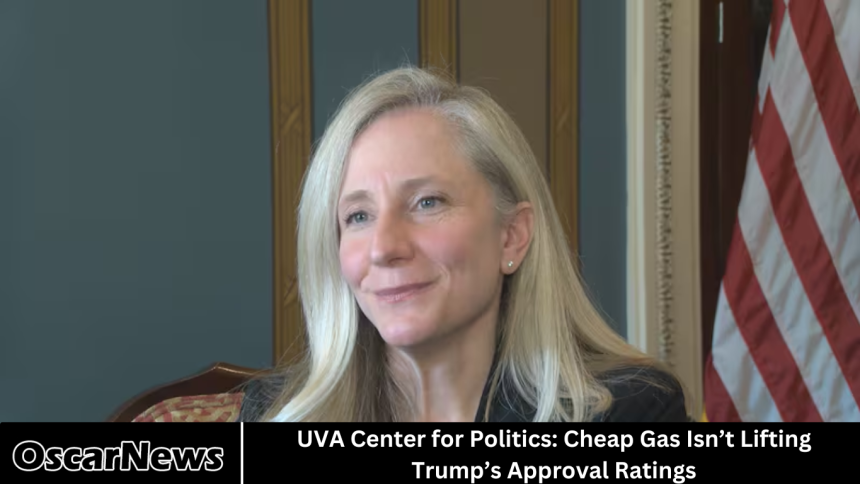
Gas prices have dropped sharply in many parts of the United States, creating relief at pumps and optimism among drivers. But the latest analysis from the University of Virginia Center for Politics shows a surprising trend: cheap gas is not improving former President Donald Trump’s approval ratings.
This finding challenges a long-standing assumption in political science: lower fuel costs usually boost presidential approval. Instead, voters appear to be influenced more by deeper political concerns, cultural issues, and party loyalty than by pocketbook benefits alone.
Why Gas Prices Usually Matter
Gas prices have always mattered in American politics. Drivers experience the cost directly, and it often becomes a major factor in how people view economic performance. When gas prices fall, voters often feel better about the economy, and historically, that has helped presidents.
But the UVA Center for Politics report suggests that the connection between gas prices and political approval has weakened, especially for Trump.
More Read: House Passes Spending Package as Lawmakers Move to Avert Shutdown
Economic signals vs. emotional signals
Lower gas prices send a clear economic signal: less inflation, more disposable income, reduced daily stress.
Yet, voters today appear to process that signal differently.
Instead of rewarding political leaders, many voters now interpret low gas prices as:
- A temporary relief, not a long-term improvement
- A result of global oil markets, not domestic leadership
- A minor issue compared with immigration, crime, or culture wars
In other words, gas prices no longer dominate voter thinking like they used to.
What the UVA Center for Politics Found
The UVA Center for Politics looked at recent polling data and compared it with gas price trends. The results were clear: Trump’s approval ratings remained stable despite falling gas prices.
Key findings
- Approval ratings show little change after price drops
- Party loyalty dominates voter response
- Issues like immigration and social policy drive opinions
- Economic improvement alone fails to shift voter attitudes
This points to a new political reality: voters are not just voters anymore—they are ideological voters.
Why Trump’s Approval Doesn’t Rise with Cheap Gas
Several factors explain why low gas prices fail to improve Trump’s approval ratings.
Strong polarization
The American electorate is more polarized than ever. Political identity often outweighs economic conditions.
A voter who dislikes Trump may still benefit from cheaper gas, but they won’t reward him politically.
Likewise, Trump supporters may praise his policies even if they feel no direct benefit from lower prices.
Economic issues no longer dominate
Today, issues like immigration, crime, national identity, and media trust dominate political discourse.
Gas prices matter, but they are no longer the headline issue that defines voter choices.
Media narratives shape perception
Media coverage shapes how voters interpret economic changes.
Even when gas prices fall, coverage may focus on:
- Geopolitical conflict
- Government policies
- Inflation concerns
- Social unrest
This framing reduces the impact of low fuel costs.
What This Means for Political Strategy
If cheap gas no longer improves approval ratings, political campaigns must adjust.
Trump campaign strategy
Trump’s campaign may need to focus less on economic performance and more on:
- Messaging around immigration
- Cultural identity
- Security
- National pride
Even economic messages may need to be framed around broader themes.
Opponent strategy
Opponents cannot rely on economic improvements alone to weaken Trump’s base.
Instead, they must focus on:
- Issues that directly affect voter values
- Local concerns
- Trust and integrity
- Long-term policy goals
Voter Behavior: A New Era
The UVA Center for Politics report highlights a shift in voter behavior.
Voters react differently now
Instead of responding to immediate economic changes, voters respond to:
- Political identity
- Social values
- Trust in institutions
- Party loyalty
This shift suggests that economic benefits no longer create political gratitude.
Gas Prices Still Matter, But Not in the Same Way
Gas prices still affect Americans daily. Cheap fuel helps families, workers, and businesses. But the political impact has changed.
Gas prices now function as a baseline
Lower gas prices may:
- Reduce financial stress
- Improve consumer confidence
- Increase disposable income
But they no longer drive major shifts in political approval.
Instead, gas prices serve as a background factor, not a decisive one.
The Bigger Trend: Policy Matters Less Than Identity
The UVA Center for Politics report points to a major trend: identity politics is winning over policy politics.
Even when economic conditions improve, voters remain loyal to their political tribe. They interpret economic changes through a filter of identity and belief.
This explains why gas prices fail to change approval
When voters are emotionally aligned with a leader, economic signals become less relevant.
When voters oppose a leader, economic signals are ignored or dismissed.
This means that gas prices no longer act as a political lever.
What’s Next for Trump Approval Ratings?
If cheap gas fails to boost approval, what could?
Potential factors that might shift approval
- Major political events
- Scandals
- Policy achievements
- Shifts in public opinion
- Economic recession or major inflation
- Security crises
In other words, approval ratings may only move during dramatic moments.
Why stability matters
Trump’s approval ratings remain steady because:
- Base supporters remain loyal
- Opponents remain opposed
- Economic improvements don’t change core beliefs
This stability may actually help Trump in long-term campaigning.
Frequently Asked Question
What did the UVA Center for Politics find?
They found that lower gas prices are not improving Trump’s approval ratings, meaning cheaper fuel isn’t changing voter support.
Why don’t low gas prices help Trump’s approval?
Voters are influenced more by political identity, immigration, crime, and cultural issues than by economic benefits like cheaper gas.
Does gas price usually affect presidential approval?
Historically, yes. Lower gas prices often boosted approval, but this trend appears weaker now.
Are voters less focused on economic issues today?
Yes. Many voters now prioritize social and cultural issues over economic indicators like fuel costs.
What does this mean for political campaigns?
Campaigns may need to focus more on values and identity-based messaging instead of relying solely on economic improvement.
Could gas prices affect approval in the future?
Only if gas price changes are dramatic and sustained, but alone, they likely won’t shift approval.
What does this trend say about U.S. politics?
It suggests polarization is stronger, and voters’ decisions rely more on party loyalty and identity than on economic conditions.
Conclusion
The UVA Center for Politics report confirms what many political analysts suspect: economic benefits no longer guarantee political support. Cheap gas provides relief for millions of Americans, but it does not create political momentum for Trump.
Instead, voter behavior now reflects deeper social divisions, stronger ideological identities, and a media environment that reinforces pre-existing beliefs.