


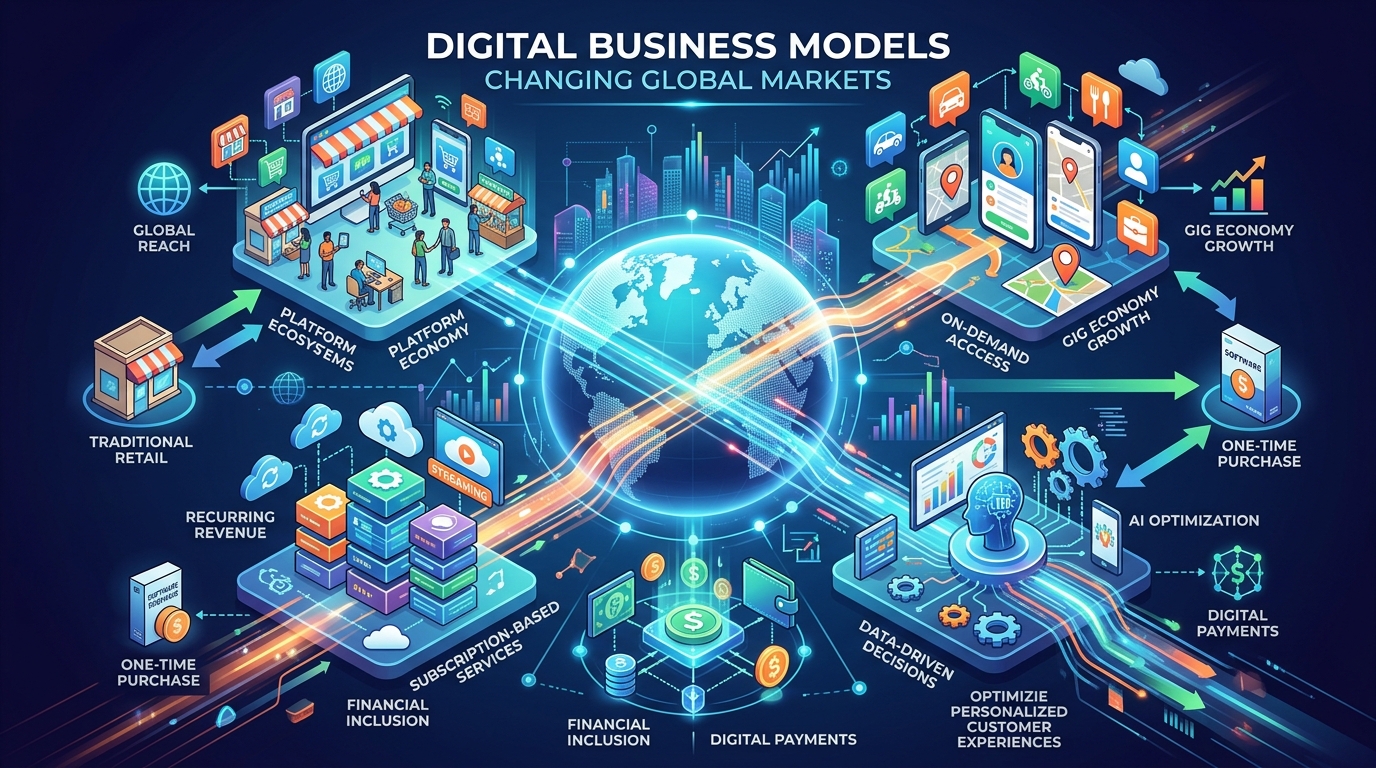
Digital business models are transforming global markets at an unprecedented speed by reshaping how companies create value, deliver services, and interact with customers. Unlike traditional systems, digital-first models rely on platforms, data, automation, and global connectivity to scale rapidly with lower costs. Businesses that adopt these models gain competitive advantages through faster innovation, improved customer experience, and expanded international reach, making digital transformation a key driver of modern economic growth.
Platform Based Business Ecosystems
Marketplace Connectivity Growth
Platform-based marketplaces connect buyers and sellers globally through digital systems that remove geographical barriers. These ecosystems enable businesses to scale quickly without owning physical inventory. Companies like e-commerce platforms rely on network effects, where more users increase value, driving exponential market expansion and efficiency.
Digital Service Aggregation
Digital aggregation platforms bring multiple services under one interface, improving user convenience and accessibility. From ride-hailing to food delivery, these systems simplify customer choices. Businesses benefit from centralized demand, better data insights, and increased transaction volume across diverse service categories.
Subscription Based Platforms
Subscription models generate recurring revenue by offering continuous access to products or services. This model ensures predictable income streams and stronger customer retention. Businesses use subscriptions in software, entertainment, and digital tools, creating long-term relationships and stable financial performance.
Ecosystem Integration Models
Integrated digital ecosystems connect multiple services within a single platform, enhancing user experience and engagement. Companies combine payments, communication, and shopping services to increase customer dependency. This approach improves retention and strengthens brand loyalty across interconnected digital environments.
Network Effect Expansion
Network effects occur when a platform becomes more valuable as more users join. This drives rapid scaling and market dominance. Businesses leveraging network effects achieve competitive advantages, making it difficult for new entrants to compete in established digital ecosystems.
| Model Type | Key Advantage | Market Impact |
|---|---|---|
| Platforms | Scalability | Global reach |
| Subscriptions | Recurring revenue | Financial stability |
| Aggregators | Convenience | User engagement |
Data Driven Business Strategies
Customer Behavior Analytics
Businesses analyze customer behavior to understand preferences, purchasing patterns, and engagement levels. This data helps improve marketing strategies and product development. Companies using analytics gain higher conversion rates and improved customer satisfaction through personalized experiences.
Predictive Market Modeling
Predictive models use historical data and AI to forecast market trends and consumer demand. This helps businesses make informed decisions and reduce risks. Accurate forecasting improves inventory management and strategic planning in competitive industries.
Real Time Decision Systems
Real-time analytics allow businesses to respond instantly to market changes. Companies can adjust pricing, marketing, and operations dynamically. This improves efficiency and ensures faster response to customer needs in rapidly changing environments.
Data Monetization Techniques
Businesses generate revenue by transforming raw data into valuable insights and services. Data monetization includes selling analytics, insights, or targeted advertising. This creates new revenue streams and strengthens digital business models.
AI Driven Personalization
AI-powered personalization customizes user experiences based on individual preferences. This increases engagement, loyalty, and conversion rates. Businesses using personalization gain a competitive edge in customer satisfaction.
E Commerce Expansion Models
Direct To Consumer Growth
Direct-to-consumer (DTC) models eliminate intermediaries, allowing brands to sell directly to customers. This increases profit margins and strengthens brand control. Companies use digital marketing to build direct relationships with consumers.
Cross Border E Commerce
Cross-border e-commerce enables businesses to sell products internationally through online platforms. This expands market reach and increases revenue opportunities. Logistics and payment integration play key roles in global expansion.
Mobile Commerce Development
Mobile commerce focuses on shopping through smartphones and apps. It enhances convenience and accessibility for users. Businesses optimize mobile platforms to increase engagement and sales conversions.
Social Commerce Integration
Social commerce combines social media and online shopping, allowing users to purchase directly from platforms. This increases impulse buying and engagement. Influencer marketing plays a major role in driving sales.
Automated Fulfillment Systems
Automation in logistics and order fulfillment improves delivery speed and accuracy. Warehouses use robotics and AI systems to manage inventory efficiently. This reduces operational costs and enhances customer satisfaction.
Artificial Intelligence Business Models
AI SaaS Platforms
AI-powered software-as-a-service platforms offer intelligent tools for businesses through subscription models. These platforms automate tasks, improve productivity, and reduce costs. SaaS models provide scalable and flexible business solutions.
Intelligent Automation Systems
AI automation replaces repetitive human tasks with intelligent systems. This improves efficiency and reduces operational errors. Businesses benefit from faster workflows and lower labor costs.
AI Powered Customer Support
Chatbots and virtual assistants handle customer queries instantly. This improves response times and reduces support costs. AI support systems enhance user experience and availability.
Machine Learning Optimization
Machine learning improves business operations by analyzing patterns and optimizing performance. Companies use it for marketing, logistics, and risk management. This increases efficiency and decision-making accuracy.
Cognitive Computing Solutions
Cognitive systems simulate human thinking to solve complex business problems. They assist in decision-making, forecasting, and strategic planning. This enhances innovation and competitiveness.
Blockchain And Decentralized Models
Decentralized Finance Systems
DeFi platforms eliminate traditional banking intermediaries, enabling peer-to-peer financial services. This increases transparency and accessibility. Users gain more control over their assets.
Smart Contract Automation
Smart contracts execute agreements automatically when conditions are met. This reduces manual intervention and increases trust. Businesses benefit from secure and efficient transactions.
Digital Asset Management
Blockchain enables secure storage and transfer of digital assets. This includes cryptocurrencies and tokenized assets. It improves transparency and reduces fraud risks.
Supply Chain Transparency
Blockchain tracks products across supply chains, ensuring authenticity and accountability. This improves trust between businesses and consumers. It reduces fraud and inefficiencies.
Tokenized Business Models
Tokenization converts assets into digital tokens for easier trading and ownership. This creates new investment opportunities and liquidity in markets.
Platform Economy And Gig Models
Freelance Marketplace Growth
Freelance platforms connect skilled workers with global clients. This creates flexible job opportunities and reduces employment barriers. Businesses gain access to diverse talent pools.
Gig Economy Expansion
Gig models allow individuals to work on short-term tasks or projects. This increases flexibility and income opportunities. Companies benefit from scalable workforce solutions.
On Demand Service Platforms
On-demand platforms provide instant services such as transport, delivery, and home services. This improves convenience and customer satisfaction.
Digital Workforce Management
Businesses manage remote and freelance workers using digital tools. This improves productivity and coordination across global teams.
Reputation Based Systems
Rating and review systems build trust between users and service providers. This ensures quality and accountability in digital platforms.
Future Of Digital Business Innovation
Metaverse Commerce Growth
Metaverse platforms create virtual marketplaces for digital and physical goods. This introduces immersive shopping experiences and new revenue streams.
Hyper Automation Expansion
Hyper automation combines AI, robotics, and analytics to automate entire business processes. This increases efficiency and reduces costs significantly.
Sustainable Digital Models
Businesses are adopting eco-friendly digital strategies to reduce environmental impact. Sustainability enhances brand value and long-term growth.
Human AI Collaboration Models
Future businesses will combine human creativity with AI efficiency. This improves innovation and decision-making across industries.
Global Digital Integration
Digital systems are connecting global markets more tightly than ever. This increases trade, collaboration, and economic interdependence.
What are digital business models?
Digital business models use online platforms, data, and technology to deliver products and services efficiently.
Why are digital models important for growth?
They enable faster scaling, lower costs, and global market access.
How does AI impact digital businesses?
AI improves automation, personalization, and decision-making.
What is platform-based business?
It is a model where digital platforms connect users, sellers, and service providers.
What is the future of digital markets?
Future markets will be AI-driven, automated, and globally interconnected.
Digital business models are reshaping global markets by enabling faster innovation, scalable platforms, and data-driven decision-making. Companies that embrace digital transformation gain stronger competitiveness and global reach. As technology continues to evolve, businesses will rely more on automation, AI, and decentralized systems, creating a future economy that is highly connected, efficient, and continuously evolving.
